

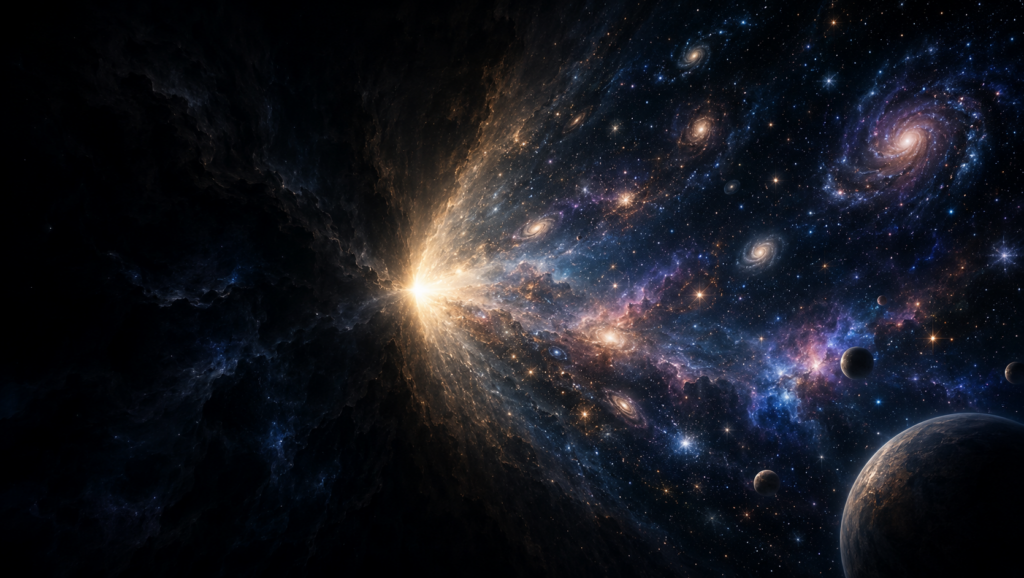
There is a question that sits quietly beneath every other question. It rarely gets asked out loud.
We ask how galaxies form. We ask how life began. We ask how the brain produces thought. These are questions about development, process, and mechanism.
But there is a deeper question underneath all of them. Why does the universe exist instead of nothing?
This is not a question about how things changed over time. It is a question about why there is anything to change at all.
We take existence for granted. We wake, we act, we plan, we wonder. Reality feels obvious. But it is not obvious. It is strange that anything exists at all.
Science can study how the universe developed. But it cannot easily explain why there is any reality to study in the first place.
The Question Behind Every Other Question
Every scientific question assumes something already exists.
Physics assumes matter and energy. Cosmology assumes space and time. Mathematics assumes structure and logic. Even the scientists asking these questions must exist themselves.
Stars exist. Galaxies exist. Atoms, forces, and minds capable of asking “why” all exist. But why does anything exist in the first place, rather than nothing at all?
This question stands behind cosmology, physics, philosophy, and theology. None of these fields can fully escape it.
If everything requires an explanation, what explains existence itself?
What Do We Mean by “Nothing”?
Before going further, it helps to ask what “nothing” actually means.
In everyday language, nothing might mean an empty room or an empty box. That is not true nothingness. It is simply the absence of objects within a space that already exists.
In physics, there is something called a quantum vacuum. It sounds like nothing, but it is not. A quantum vacuum is a state within a physical field, governed by physical laws. It has structure. It has properties. It is something.
Empty space itself is not absolute nothing either. Space has geometry. It can expand, bend, and interact with matter and energy.
Physical laws are not nothing. Mathematical structure is not nothing. These are real features of reality, even if they cannot be touched or seen directly.
Philosophical nothing means something far more extreme. It means no space, no time, no matter, no energy, no fields, no laws, no mathematics, no potential, and no reality of any kind.
When people say the universe came from “nothing,” they do not always mean this deeper, stricter kind of nothing. This distinction matters. It shapes what a scientific explanation can and cannot claim.
What Science Can Tell Us
Modern cosmology describes the early universe with impressive precision.
The Big Bang model does not describe an explosion happening inside empty space. It describes the expansion of space itself, starting from an extremely hot, extremely dense early state.
Several major lines of evidence support this model. Cosmic microwave background radiation offers a faint afterglow from the early universe. The expansion of galaxies shows that space itself is stretching over time. The observed abundance of light elements, like hydrogen and helium, matches predictions from early universe conditions.
Science studies physical causes, patterns, and mathematical models. It is a remarkably powerful way of understanding how the universe developed. Anyone curious about that earlier chapter might explore [Internal link suggestion: link “what may have existed in the moments before this expansion began” to “What Existed Before the Big Bang?”], or the related idea of [Internal link suggestion: link “a rapid early stretching of space known as cosmic inflation” to “What Is Cosmic Inflation?”].
But science may not be built to answer every kind of “why” question. It can describe what happened after a certain point. It may not explain why there was anything capable of happening in the first place.
Does the Big Bang Answer the Question?
The Big Bang model helps explain how the observable universe developed from an early state. It does not necessarily explain why reality exists at all.
It does not automatically explain why there are laws of physics. It does not fully explain why there is something rather than nothing.
Some scientific models propose earlier cosmic phases. Others explore quantum cosmology, bouncing universes, eternal inflation, or multiverse theories. Readers wondering whether any of these ideas mark a true starting point can look into [Internal link suggestion: link “whether the Big Bang was really the absolute beginning of everything” to “Was the Big Bang Really the Beginning of Everything?”].
These are serious scientific ideas, still being explored and debated. But most of them still require some kind of prior reality. They may need laws, fields, structure, or a mathematical framework already in place.
Does explaining the universe’s development answer why there is a universe to develop?
Why Do the Laws of Physics Exist?
The universe does not behave randomly, in the sense of complete chaos. It follows consistent, describable patterns.
Gravity, electromagnetism, quantum mechanics, and relativity all describe deep, reliable order. This order allows galaxies to form, atoms to bond, and stars to burn in predictable ways.
This raises a set of quiet but persistent questions.
Why are there laws at all, instead of pure disorder? Why are these laws stable across billions of years? Why are they written in a language the human mind can understand?
The existence of stable, discoverable laws is one of the quiet mysteries behind science itself. Science depends on order being real. It rarely asks why that order exists. For a closer look at this puzzle, see [Internal link suggestion: link “why physical laws exist and behave so consistently” to “Why Do the Laws of Physics Exist?”].
These questions move beyond physics itself. They enter philosophy.
Could the Universe Be Necessary?
One philosophical answer suggests the universe exists necessarily. On this view, the universe could not have failed to exist.
This is a serious position, held by some thoughtful philosophers and scientists. It treats existence itself as somehow built into the nature of reality.
But this view faces a challenge. The universe appears contingent in many ways.
Its physical constants could plausibly have been different. Its early structure could have unfolded differently. Its beginning does not obviously explain itself. Questions about calibration connect to the ongoing discussion of [Internal link suggestion: link “whether the universe’s constants appear finely tuned for life” to “Is the Universe Fine-Tuned for Life?”].
This does not settle the debate. The necessary-universe view remains actively discussed among philosophers and physicists alike.
Could the Universe Come from Nothing?
Some physicists have proposed models describing a “universe from nothing.”
These are careful, mathematically serious proposals. But it is worth asking what “nothing” means in each case.
Many of these models do not describe absolute philosophical nothing. They often involve quantum laws, energy fields, gravitational principles, or an underlying mathematical structure.
This leads to an important point. If laws already exist, that is already something. If a quantum vacuum already exists, that is already something. If a mathematical framework already exists, that is already something too.
This does not make these scientific models useless. It simply means they may not answer the deepest version of the question. A true account of absolute nothing would still need to explain why even these deeper structures exist.
Could God Explain Why Anything Exists?
Many religious and philosophical traditions offer a different kind of answer.
They argue that all contingent reality depends on a necessary foundation beyond itself. This foundation is often described as God, the Creator, or the ground of being.
This is not a claim that science has proven God exists. It is a philosophical proposal, offered as one possible explanation for why contingent reality exists at all.
This is not a “God of the gaps” argument. It does not simply say science does not know, therefore God. It asks a different question: whether reality itself needs a deeper foundation, regardless of how much science eventually explains.
The idea of God and the universe, in this view, is less about filling a gap in physics. It is about answering why there is reality at all, rather than none.
Why This Question Still Matters
This question matters because human beings are not simply calculating machines.
We ask about meaning. We ask about purpose. We ask about origin and destiny. These questions sit alongside our scientific curiosity, not against it.
The existence of the universe touches science, philosophy, and personal reflection all at once.
A person can study cosmology in careful detail and still wonder something deeper. Why is there a universe capable of producing stars, planets, life, consciousness, love, beauty, and moral awareness? Some of that wondering connects to bigger methodological questions, like [Internal link suggestion: link “whether science can ultimately explain everything about reality” to “Can Science Explain Everything?”] and [Internal link suggestion: link “the difference between what counts as evidence and what counts as proof” to “What Is the Difference Between Evidence and Proof?”].
A Humble Conclusion
The question “why does the universe exist instead of nothing” does not have a single, agreed-upon answer.
Science gives us extraordinary knowledge about how the universe developed, structured itself, and became knowable.
Philosophy helps us examine the deeper assumptions hiding beneath every scientific claim.
Faith offers one possible ultimate explanation, though not a scientific proof.
None of these approaches alone closes the question completely. Together, they help us hold it honestly.
The fact that anything exists at all may be the first miracle we overlook every day.
AI Image Instructions
1. Image Title: Threshold of Existence
- Where to use it: Featured image
- Recommended size: 1672 x 941 pixels
- AI image prompt: A vast, cinematic cosmic scene emerging from deep, absolute blackness, showing the faint first emergence of light, diffuse galaxies, and scattered stars taking shape at the edge of darkness. Documentary-style astrophotography aesthetic, subtle gradients from black to deep blue and amber, sense of profound mystery and scale, no text, no human figures. Add a subtle “GodOrNot.org” watermark in the bottom right corner, small white text, readable, about 20–30% opacity.
- Suggested filename: threshold-of-existence-featured.png
- Suggested alt text: Light emerging from cosmic darkness, representing the mystery of why the universe exists instead of nothing
2. Image Title: Layers of Nothing
- Where to use it: Infographic
- Recommended size: 1400 x 800 pixels
- AI image prompt: A clean, minimalist educational infographic on a dark navy background comparing five concepts in a horizontal progression: absolute philosophical nothing shown as pure black void, empty space shown as subtle geometric grid, quantum vacuum shown as a faint shimmering particle field, physical laws shown as elegant thin equation symbols, and the observable universe shown as galaxies and stars. Scientific, elegant iconography, soft glowing accents, clear visual hierarchy, minimal text. Add a subtle “GodOrNot.org” watermark in the bottom right corner, small white text, readable, about 20–30% opacity.
- Suggested filename: layers-of-nothing-infographic.png
- Suggested alt text: Infographic comparing philosophical nothing, empty space, quantum vacuum, physical laws, and the observable universe
3. Image Title: The Hidden Order
- Where to use it: In-article image
- Recommended size: 1400 x 800 pixels
- AI image prompt: A deep cosmic background featuring elegant, softly glowing mathematical equations, orbital paths, gravitational curve lines, and light wave patterns intertwined with distant galaxies. Sense of hidden order and intelligibility within the universe, refined and scientific, uncluttered composition, dark background with subtle gold and blue light accents. Add a subtle “GodOrNot.org” watermark in the bottom right corner, small white text, readable, about 20–30% opacity.
- Suggested filename: the-hidden-order-physics-visual.png
- Suggested alt text: Mathematical patterns and cosmic structures representing the laws of physics and the order of the universe
4. Image Title: From Fire to Thought
- Where to use it: Infographic / Section divider
- Recommended size: 1400 x 800 pixels
- AI image prompt: A horizontal scientific timeline illustration on a dark background showing sequential stages: an extremely hot dense early universe, cosmic inflation depicted as expanding light lines, galaxy formation, star birth, planet formation, early Earth, early life forms, and a small abstract glowing symbol representing conscious thought at the far end. Clean documentary infographic style, subtle glowing nodes connecting each stage, minimal text. Add a subtle “GodOrNot.org” watermark in the bottom right corner, small white text, readable, about 20–30% opacity.
- Suggested filename: from-fire-to-thought-timeline.png
- Suggested alt text: Timeline from the early universe through cosmic inflation, galaxy formation, and the emergence of conscious inquiry
5. Image Title: The Waiting Instrument
- Where to use it: In-article image / Section divider
- Recommended size: 1400 x 800 pixels
- AI image prompt: An empty modern observatory interior at night, with a large telescope pointed upward through an open dome toward a deep starfield and distant galaxies. No human figures present. Soft ambient light from the night sky entering the dome, quiet and contemplative atmosphere, realistic architectural detail, cinematic documentary lighting. Add a subtle “GodOrNot.org” watermark in the bottom right corner, small white text, readable, about 20–30% opacity.
- Suggested filename: the-waiting-instrument-observatory.png
- Suggested alt text: An empty observatory facing deep space, symbolizing human inquiry into why the universe exists