

Consciousness is one of the greatest mysteries in science and philosophy. Can awareness be fully explained by matter, or does it point to something deeper about reality?
What Is Consciousness and Where Does It Come From?
Consciousness is one of the greatest mysteries in science and philosophy. Every human being experiences it directly, yet no one fully understands its origin. We see colors, hear music, feel emotions, form memories, and experience a rich inner world. But where does this awareness come from?
Scientists have made remarkable discoveries about the brain. They can identify regions associated with memory, language, emotion, and decision-making. Yet a profound question remains unanswered: Why does any of this produce conscious experience at all?
This question sits at the center of the debate about the origin of consciousness. It also raises deeper questions about reality, human identity, and whether consciousness may point to something beyond matter alone.
What Is Consciousness?
At its simplest, consciousness refers to subjective experience. It is the awareness of being aware.
When you see a sunset, hear your favorite song, or feel joy, you experience consciousness. These experiences are not merely physical events. They are first-person experiences that exist within your mind.
This creates a fascinating challenge. Modern science can study brain activity, but it cannot directly observe what it feels like to be another person. The inner experience itself remains private.
This is why many researchers distinguish between brain activity and conscious awareness.
The question “what is consciousness” remains one of the most important questions in science and philosophy.
The Hard Problem of Consciousness
The Hard Problem of Consciousness (H2)
The philosopher David Chalmers introduced the phrase “hard problem of consciousness.”
Scientists can explain many functions of the brain…
These are often called the “easy problems”…
The hard problem of consciousness is different.
Why should physical brain activity produce subjective experience at all?
Why does seeing red feel like something?
Why does pain feel painful?
Why does awareness exist?
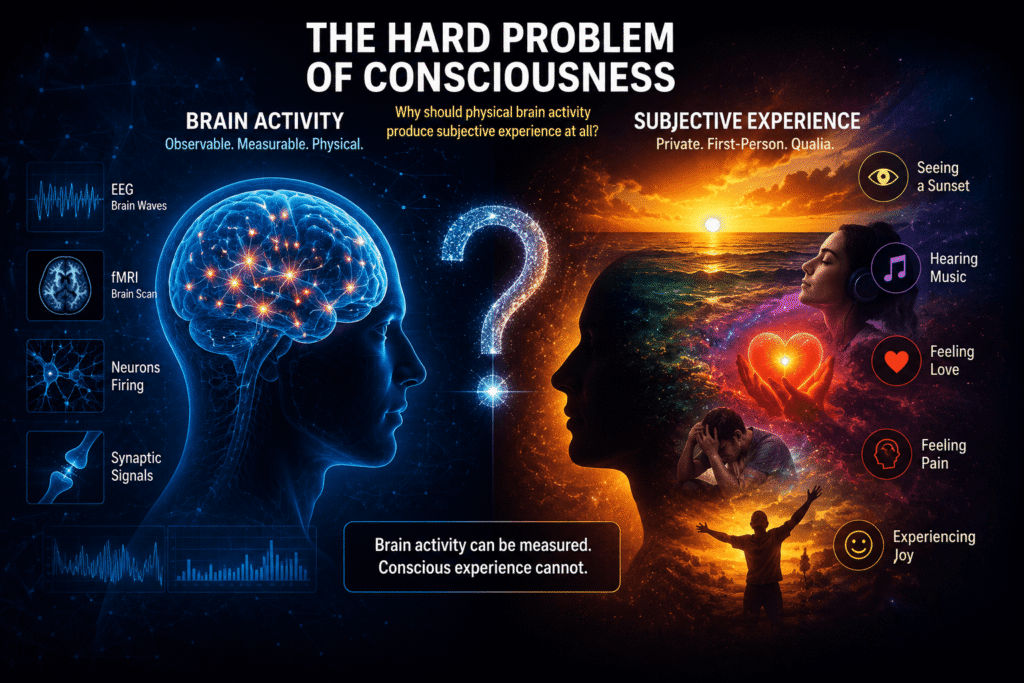
Caption:
Brain activity can be measured. Conscious experience cannot. Why physical brain activity gives rise to subjective awareness remains one of science’s greatest unanswered questions.
Many scientists acknowledge that this question remains unresolved.
The hard problem of consciousness continues to challenge materialistic explanations of reality.
There is no doubt that the brain and consciousness are closely connected.
Brain injuries can alter personality.
Drugs can affect perception.
Damage to certain regions can impair memory or awareness.
These observations demonstrate a powerful relationship between consciousness and the brain.
However, correlation does not automatically explain origin.
A radio depends on its circuitry to receive a signal. Yet the signal itself does not originate inside the radio.
Some researchers argue that the brain may generate consciousness.
Others suggest that the brain may process or transmit consciousness in ways not yet understood.
The relationship between mind and brain remains one of the central questions in consciousness studies.
The Mystery of Subjective Experience
One of the most fascinating aspects of consciousness is subjective experience.
Scientists often use the term “qualia” to describe the personal qualities of experience.
The redness of red.
The taste of chocolate.
The feeling of love.
The experience of music.
Every conscious person recognizes these experiences instantly, yet science still struggles to explain why they exist at all.
A scientist can know everything about light wavelengths and still not know what the color red looks like to another person.
This challenge has fueled decades of debate in philosophy of mind.
It remains one of the strongest arguments that consciousness may involve more than physical processes alone.
Can Matter Create Consciousness?
Many researchers believe consciousness emerges from matter.
According to this view, consciousness is the product of highly organized neural activity.
As brains became more complex through evolution, conscious awareness emerged.
This explanation appeals to many scientists because it relies on natural physical processes.
However, critics argue that emergence does not explain how subjective awareness arises.
Even if every neuron were mapped perfectly, would that explain why experience exists?
Can matter create consciousness?
Can physical processes alone generate awareness?
These questions remain open.
No widely accepted scientific explanation currently explains how unconscious matter becomes conscious experience.
The Origin of Consciousness
The origin of consciousness remains one of the deepest mysteries in human knowledge.
Several major theories attempt to explain it.
Physicalism
Physicalism argues that consciousness is entirely produced by physical processes in the brain.
Everything about awareness ultimately reduces to matter and energy.
Emergent Consciousness
Emergent consciousness suggests that awareness appears when systems become sufficiently complex.
According to this view, consciousness emerges from interactions among billions of neurons.
Integrated Information Theory
Integrated Information Theory proposes that consciousness arises from integrated information within a system.
The more unified and interconnected the information, the greater the consciousness.
Global Workspace Theory
Global Workspace Theory suggests that consciousness occurs when information becomes globally available throughout the brain.
This theory focuses on how information is processed and shared.
While these theories provide valuable insights, none fully solves the hard problem of consciousness.
Although these theories differ significantly, none has achieved broad scientific consensus as a complete explanation for conscious experience.
Consciousness and Human Identity
Consciousness plays a central role in human identity.
Your memories, beliefs, values, and experiences contribute to your sense of self.
Without consciousness, concepts such as personal identity, morality, and responsibility become difficult to define.
This connection raises profound questions.
What makes you the same person throughout your life?
What is the nature of self-awareness?
Why are humans conscious in ways that appear unique among living creatures?
These questions continue to drive research into consciousness and human experience.
Consciousness and Free Will
The debate about consciousness and free will remains highly active.
If human thoughts are entirely determined by physical processes, do we truly possess freedom?
Many people experience themselves as decision-makers.
They feel capable of choosing between alternatives.
This sense of agency appears deeply connected to conscious awareness.
Some researchers argue that free will is an illusion.
Others believe conscious choice reflects a genuine aspect of reality.
Regardless of the answer, consciousness and free will remain closely linked.
Is Consciousness Evidence of Something Beyond Matter?
Many philosophers and thinkers believe consciousness may point beyond purely material explanations. They argue that awareness, reason, intentionality, and subjective experience are difficult to reduce to matter alone.
This does not prove any particular worldview. However, it raises important questions.
Does consciousness transcend matter?
Is consciousness more than the brain?
Does the existence of awareness reveal deeper aspects of reality?
These questions continue to inspire debate among scientists, philosophers, theologians, and ordinary people.
Consciousness and Meaning
Human beings do more than process information.
We seek purpose.
We ask questions about truth.
We search for beauty.
We pursue meaning.
This connection between consciousness and meaning distinguishes human experience from simple computation.
A computer can process data.
A person can wonder why existence exists at all.
This ability to reflect on reality may be one of the most remarkable features of consciousness.
The search for meaning of human existence is closely tied to the mystery of awareness itself.
Conclusion
What is consciousness and where does it come from?
Despite tremendous advances in neuroscience, no complete answer exists.
Scientists understand more about the brain than ever before, yet subjective experience remains one of science’s greatest mysteries.
The hard problem of consciousness continues to challenge researchers across multiple disciplines.
Whether consciousness ultimately emerges from matter, reflects deeper laws of reality, or points beyond the physical world remains one of humanity’s greatest unanswered questions.
What is certain is that consciousness stands at the center of human existence. It shapes our experiences, our relationships, our search for truth, and our understanding of reality itself.
As we continue exploring the mystery of awareness, consciousness may prove to be one of the most important clues to understanding not only who we are, but the nature of reality itself.