

What Is Cosmic Inflation?
Cosmic inflation is a theory about the universe’s first moments. It says space itself expanded at an incredible rate, just after the Big Bang.
This expansion happened in a tiny fraction of a second. In that instant, the universe grew from smaller than an atom to a size vastly larger than before.
Inflation is not the Big Bang itself. It is a brief, explosive event that happened right after it. Physicists proposed inflation to solve problems the standard Big Bang model could not explain.
Today, cosmic inflation is a leading idea in modern cosmology. Many astronomers see it as the best explanation for how our universe came to look the way it does.
Why Did Physicists Propose Inflation?
By the late 1970s, the Big Bang model faced a challenge. It described the universe’s expansion well. But it left three major puzzles unsolved.
These puzzles involved the universe’s shape, its uniform temperature, and missing particles predicted by physics. Something was missing from the story.
Physicist Alan Guth proposed a solution in 1979. He suggested a short burst of rapid expansion before the traditional Big Bang expansion took over. This idea became cosmic inflation.
Inflation elegantly solved all three puzzles at once. That is a major reason scientists took it seriously.
The Horizon Problem
The universe looks remarkably uniform. Look in any direction, and the cosmic microwave background has nearly the same temperature.
This is strange. Regions on opposite sides of the sky are too far apart to have ever exchanged heat or light. Without contact, they should not match so closely.
This puzzle is called the Horizon Problem. Under standard Big Bang expansion, distant regions never had time to reach the same temperature.
Inflation offers an answer. Before inflation, these regions sat close together. They had time to reach a shared temperature. Then inflation stretched them far apart, preserving that uniformity.
The Flatness Problem
Space can curve in different ways. It might curve like a sphere, curve like a saddle, or lie flat.
Observations show our universe is remarkably flat. Its geometry follows the simple rules of Euclidean space almost perfectly.
This flatness is odd. Small deviations from flatness, present in the early universe, should have grown dramatically over time. Yet the universe stayed extraordinarily flat.
This is the Flatness Problem. It suggests the early universe started with an almost impossibly precise balance.
Inflation resolves this naturally. Rapid expansion flattens space, similar to how a balloon’s surface looks flatter as it inflates. Any early curvature gets stretched away.
The Magnetic Monopole Problem
Certain physics theories predict strange particles called magnetic monopoles. These would carry an isolated north or south magnetic charge.
Normal magnets always have both poles. Monopoles would exist alone. Early-universe physics suggests monopoles should have formed in large numbers.
Yet scientists have never detected one. This gap between prediction and observation is the Magnetic Monopole Problem.
Inflation offers an explanation. Rapid expansion would dilute any monopoles enormously. They would become so rare that finding one becomes extremely unlikely.
Alan Guth’s Inflation Theory
Alan Guth, an American physicist, first proposed inflation theory in 1979. He was studying monopole formation when he found a surprising solution.
Guth realized a specific kind of energy field could drive extreme, temporary expansion. Researchers now call this the inflaton field.
His original model needed refinement. Other physicists, including Andrei Linde, Paul Steinhardt, and Andreas Albrecht, improved the details soon after.
Together, they built the framework known today as inflation theory. Guth remains widely credited as the idea’s originator.
How Cosmic Inflation Worked
Inflation theory centers on a hypothetical field of energy, the inflaton. This field filled the extremely early universe.
For a brief moment, the inflaton field held unusual properties. It created a kind of negative pressure. This pressure caused space to expand at an accelerating, exponential rate.
The scale of this expansion is hard to grasp. In roughly a trillionth of a trillionth of a trillionth of a second, space expanded by a factor of at least 10^26.
This expansion stretched space itself, not objects moving through it. Distant points separated far faster than the speed of light, without violating relativity, because space itself was growing.
How Inflation Ended and the Hot Big Bang Began
Inflation could not continue forever. Eventually, the inflaton field lost its unusual energy state.
As the field settled, it released its stored energy. This energy converted into a hot, dense soup of particles and radiation.
Physicists call this moment reheating. It marks the end of inflation and the beginning of the standard Hot Big Bang phase.
From here, familiar physics takes over. The universe kept expanding, but far more gradually. It cooled, formed atoms, and eventually built stars and galaxies.
Quantum fluctuations, tiny random variations from the inflationary period, played a crucial role too. Inflation stretched these microscopic ripples across enormous distances.
These ripples became slight differences in density across the young universe. Regions with slightly more matter attracted more material through gravity.
Over billions of years, those small density differences grew. They became the seeds for galaxies, galaxy clusters, and the universe’s large-scale structure.
Evidence Supporting Cosmic Inflation
Cosmic inflation remains a scientific model, not directly observed. But several lines of evidence support it strongly.
The Cosmic Microwave Background, or CMB, offers the clearest evidence. This faint radiation fills the entire sky, left over from the universe’s early hot phase.
Detailed CMB maps, from missions like COBE, WMAP, and Planck, show tiny temperature variations. Inflation predicted the exact statistical pattern these variations follow.
The universe’s large-scale structure also matches inflation’s predictions. Galaxy surveys show matter arranged in patterns consistent with inflation-seeded fluctuations.
Additionally, precise measurements confirm the universe’s flatness. This matches what inflation predicts, rather than the fine-tuned flatness the standard Big Bang model would require.
Together, these observations make inflation the most widely accepted explanation among cosmologists, even though direct proof remains elusive.
Eternal Inflation and Bubble Universes
Some inflation models lead to a striking idea: inflation might never fully stop. Physicists call this eternal inflation.
In these models, inflation ends in some regions but continues elsewhere. Our observable universe would then be just one “bubble” where inflation ended.
This raises the hypothesis of a multiverse. Other bubble universes might exist beyond our own, each with potentially different physical properties.
It’s important to note: bubble universes and eternal inflation remain hypotheses. They extend from inflation theory but currently lack direct observational evidence.
Many physicists find these ideas mathematically compelling. Still, they remain speculative extensions, not confirmed science.
What Scientists Still Don’t Know
Cosmic inflation answers many questions, but leaves others open. Researchers still don’t know what the inflaton field actually is.
No experiment has directly detected an inflaton particle. Its physical nature remains theoretical, inferred from its effects rather than observed directly.
Scientists also debate exactly which inflation model fits reality best. Multiple versions exist, each with different mathematical details.
Some physicists have raised deeper questions about inflation’s overall framework. They ask whether it truly solves the problems it claims to, or introduces new ones.
Ongoing research, especially into gravitational waves from the early universe, may offer new clues. Detecting specific patterns could confirm or challenge current inflation models.
Frequently Asked Questions
What is cosmic inflation in simple terms?
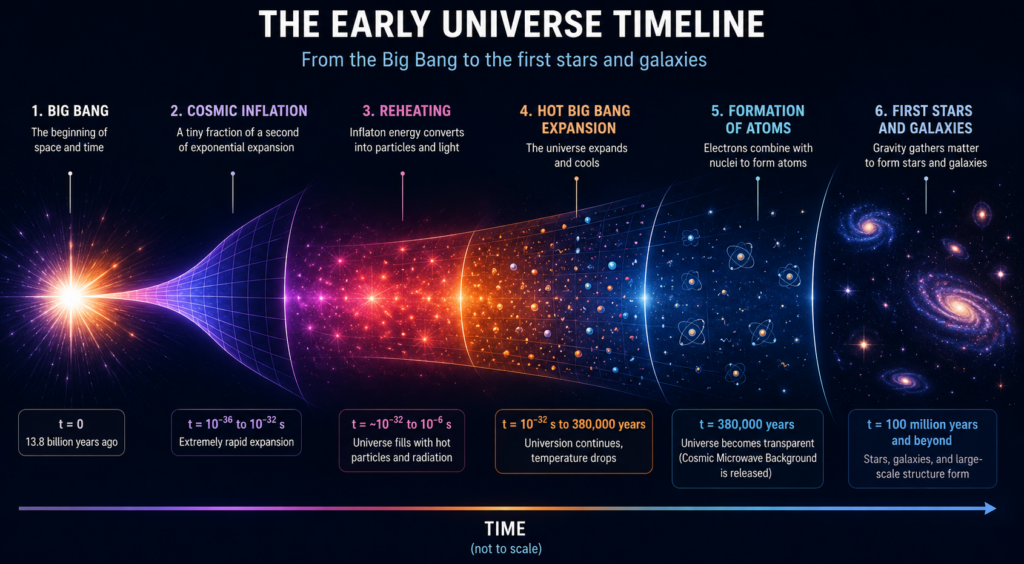
Figure 1. Timeline illustrating the major stages in the early universe, from the Big Bang and cosmic inflation through the formation of atoms, the first stars, and galaxies.
Who proposed the theory of cosmic inflation?
Physicist Alan Guth first proposed inflation theory in 1979. Other scientists, including Andrei Linde, later refined the model further.
What problems does inflation theory solve?
Inflation addresses the Horizon Problem, Flatness Problem, and Magnetic Monopole Problem. These were unresolved puzzles within the standard Big Bang model.
Is there proof that cosmic inflation happened?
There’s no direct proof, but strong indirect evidence exists. Cosmic Microwave Background patterns and large-scale structure both match inflation’s predictions closely.
What is the difference between inflation and the Big Bang?
The Big Bang describes the universe’s overall expansion from a hot, dense state. Inflation is a specific, brief period of accelerated expansion that occurred just after it began.
Image 2: Horizon Problem
- Placement: Within “The Horizon Problem” section
- SEO filename: horizon-problem-cosmic-inflation.jpg
- Alt text: Diagram illustrating the Horizon Problem in cosmology showing distant regions of equal temperature
- Figure caption: The Horizon Problem: distant regions share the same temperature despite never being in contact.
- AI image prompt: “Create an educational science diagram showing two opposite regions of the observable universe as glowing spheres on either side of a dark space background, with a small central point representing Earth’s viewpoint. Draw dotted lines between the two regions with a red ‘X’ or broken-line symbol to show no possible causal contact. Label the regions ‘Region A’ and ‘Region B’ with matching temperature icons or color gradients to show equal temperature. Style: minimalist, clean space-themed infographic, dark background, soft blue and orange color palette, easy to understand for a general audience.”
Image 3: Flatness Problem
- Placement: Within “The Flatness Problem” section
- SEO filename: flatness-problem-universe-geometry.jpg
- Alt text: Illustration comparing flat, spherical, and saddle-shaped models of universe geometry
- Figure caption: The universe’s geometry could be flat, spherical, or saddle-shaped. Observations show it is nearly flat.
- AI image prompt: “Create a three-panel scientific infographic comparing three possible shapes of the universe’s geometry: a flat grid plane, a curved sphere grid, and a curved saddle-shaped grid. Label each panel clearly: ‘Flat’, ‘Spherical (Closed)’, ‘Saddle-Shaped (Open)’. Use a soft grid-line texture over each shape to show geometric curvature, with a glowing highlight around the ‘Flat’ panel to indicate it matches our universe. Style: clean 3D-rendered educational diagram, cool blue and white color scheme, dark background, professional science-communication look.”
Image 4: How Cosmic Inflation Expanded Space
- Placement: Within “How Cosmic Inflation Worked” section
- SEO filename: how-cosmic-inflation-expanded-space.jpg
- Alt text: Illustration of space rapidly expanding during cosmic inflation
- Figure caption: During inflation, space itself expanded at an extraordinary, accelerating rate.
- AI image prompt: “Create a dynamic scientific illustration showing a small glowing point of light rapidly expanding outward into a large sphere of stretched, grid-lined space, symbolizing the expansion of space itself during cosmic inflation. Use motion-blur style radiating lines and a gradient from bright white-gold at the center to deep blue and purple at the edges. Avoid depicting a literal explosion; instead emphasize smooth, stretching expansion. Style: high-quality digital space art, scientifically inspired, suitable for an educational cosmology article, no readable text in the image.”
Image 5: Cosmic Microwave Background
- Placement: Within “Evidence Supporting Cosmic Inflation” section
- SEO filename: cosmic-microwave-background-map.jpg
- Alt text: Illustration representing the Cosmic Microwave Background radiation across the sky
- Figure caption: The Cosmic Microwave Background shows tiny temperature variations that support inflation theory.
- AI image prompt: “Create a stylized, scientifically inspired illustration of the Cosmic Microwave Background as an all-sky oval map, similar in style to Planck satellite images. Use a mottled pattern of orange, red, yellow, and blue speckles representing tiny temperature fluctuations across the sky. Ensure the pattern looks organic and random, not symmetrical or repeating. Style: high-resolution scientific visualization, dark background, vibrant heat-map color palette, no text or labels, suitable for a general-audience science article.”
Image 6: Eternal Inflation and Bubble Universes (Hypothesis)
- Placement: Within “Eternal Inflation and Bubble Universes” section
- SEO filename: eternal-inflation-bubble-universes-hypothesis.jpg
- Alt text: Conceptual illustration of eternal inflation and bubble universes, labeled as a hypothesis
- Figure caption: Hypothesis: eternal inflation may produce many separate bubble universes.
- AI image prompt: “Create a conceptual space-art illustration showing multiple translucent glowing spheres, or ‘bubbles’, of varying sizes floating within a vast dark cosmic background filled with faint stars and nebula-like textures. Each bubble should have a slightly different internal color (blue, purple, green, orange) to suggest different physical properties. Include a clearly visible text label in the corner of the image reading ‘HYPOTHESIS’ in a simple sans-serif font, styled like a scientific diagram watermark. Style: artistic yet scientifically-inspired, dark background, dreamlike but professional, appropriate for a cosmology education article.”