

Few questions pull at the human mind quite like this one. What existed before the Big Bang? Was there a “before” at all?
It sounds like a simple question. It isn’t. Answering it forces us to confront the limits of physics, language, and even logic itself.
The Big Bang Theory is one of science’s greatest achievements. It explains, with remarkable precision, how our universe evolved from a hot, dense state 13.8 billion years ago into the galaxies, stars, and planets we see today.
But here’s the honest truth: the Big Bang Theory describes what happened after the beginning. It does not tell us, with certainty, what came before it — or whether “before” even makes sense.
This article explores what modern cosmology, physics, and philosophy have to say. We’ll separate solid evidence from hypothesis, and hypothesis from speculation.
The Standard Big Bang Model: What We Actually Know
The Big Bang Model describes the universe expanding from an extremely hot, dense state. It is supported by strong observational evidence.
Three pillars back it up:
- The cosmic microwave background radiation, the faint afterglow of the early universe
- The observed expansion of galaxies, first documented by Edwin Hubble
- The abundance of light elements like hydrogen and helium, which match Big Bang predictions
Belgian physicist and priest Georges Lemaître first proposed the idea in 1927, calling it the “primeval atom.” Einstein famously called Lemaître’s math “the most beautiful” he had ever seen, even while doubting its physical reality at first.
The model is not a story about an explosion in space. It’s better understood as the rapid stretching of space itself, starting from an extremely compact state.
General Relativity and the Problem of Space-Time
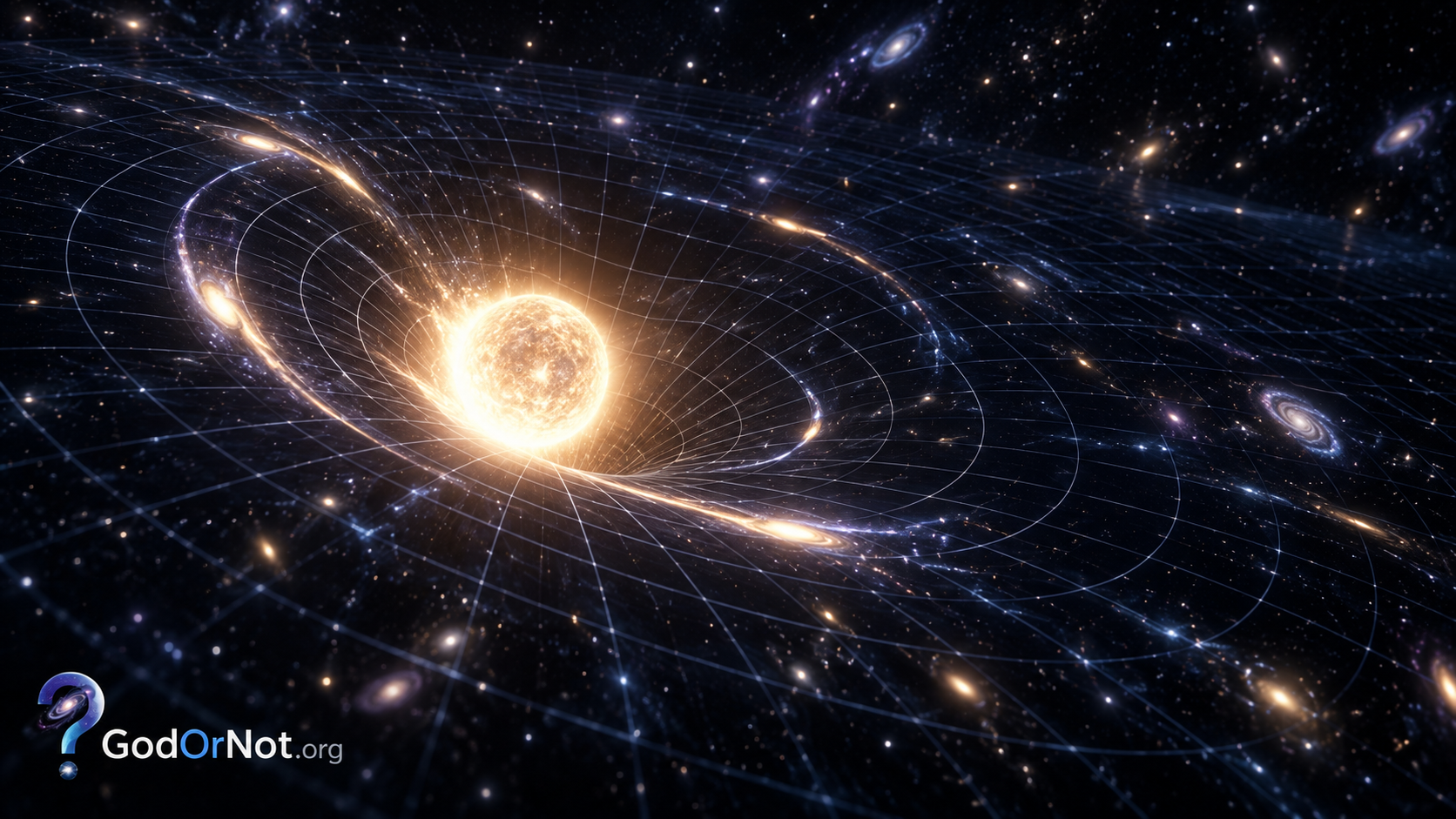
To understand why “before the Big Bang” is such a tricky phrase, we need Albert Einstein’s general relativity.
General relativity treats space and time not as separate things, but as one interwoven fabric: space-time. Matter and energy bend this fabric, and that bending is what we experience as gravity.
Crucially, the Big Bang wasn’t just the beginning of matter. According to general relativity, it was also the beginning of space and time themselves.
If time itself began at the Big Bang, then asking “what happened before it” may be like asking what’s north of the North Pole. The question assumes a framework — a “before” in time — that may not have existed yet.
Why “Before” May Not Be a Meaningful Question
This is one of the most important and least intuitive ideas in cosmology.
If time started at the Big Bang, there was no earlier moment for anything to happen in. Not emptiness, not silence, not “nothing” waiting around — simply no time at all.
This doesn’t mean the question is unimportant. It means our everyday concept of “before” may not apply to the edge of time itself.
Some physicists take this view seriously. Others believe time may extend beyond the Big Bang in ways we don’t yet understand. Both positions are actively debated.
Cosmic Inflation and Eternal Inflation
Cosmic inflation, developed largely by physicist Alan Guth in 1980, proposes that the universe underwent an incredibly rapid expansion in its first fraction of a second.
Inflation helps explain why the universe looks so uniform and flat across vast distances. It’s widely accepted among cosmologists, though the exact mechanism remains under study.
Alan Guth first proposed the theory of cosmic inflation in 1980. Later, Andrei Linde expanded the concept into eternal inflation, suggesting that inflation may continue indefinitely in some regions of space, producing countless “bubble universes.”
Alan Guth→ Wikipedia.
Andrei Linde → Wikipedia.
The Multiverse Hypothesis
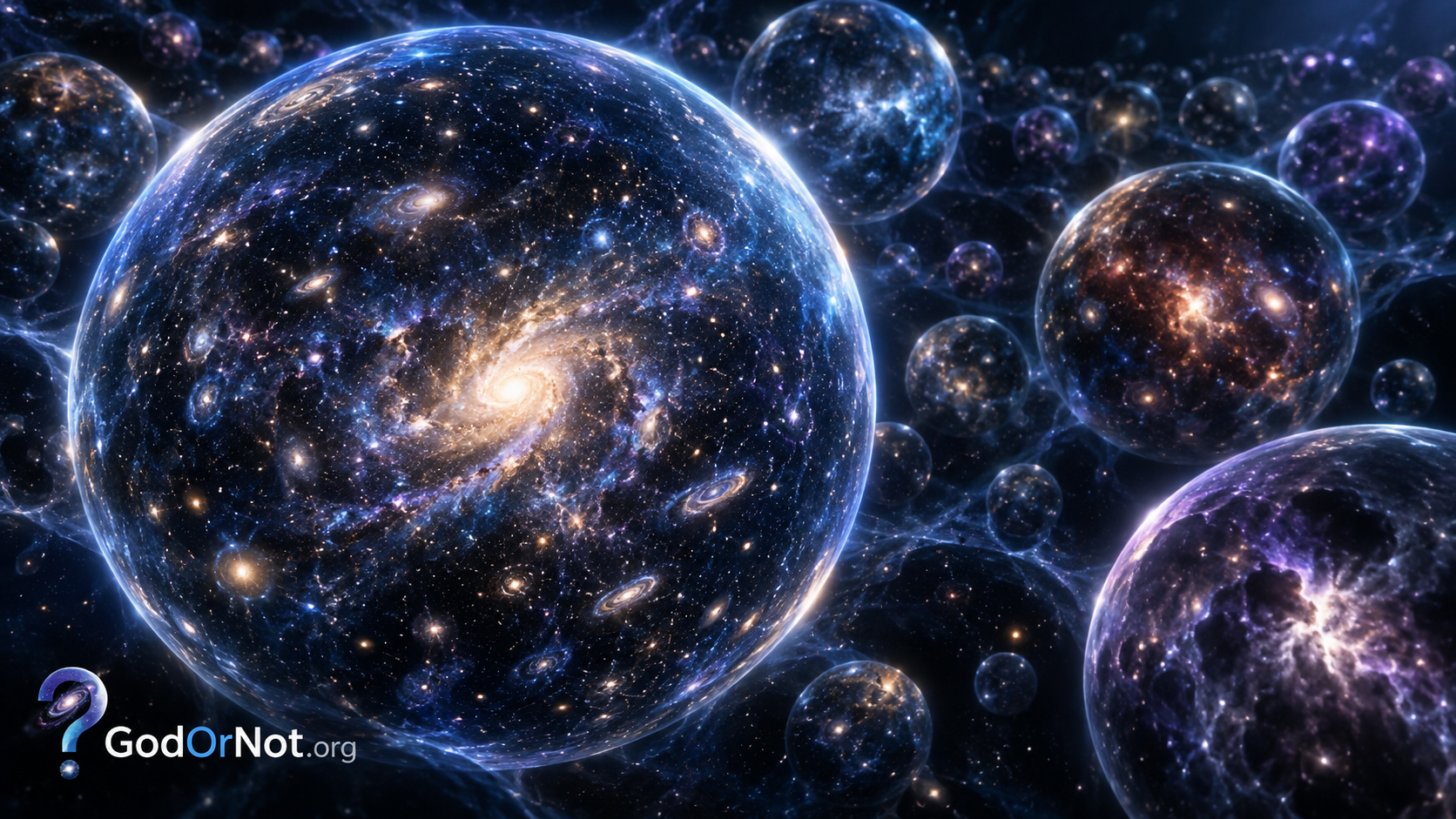
Eternal inflation naturally leads to the multiverse hypothesis — the idea that our universe is one of many, each potentially with different physical laws.
The multiverse is a fascinating and philosophically rich idea. It’s also, importantly, unproven.
No experiment has directly detected another universe. For now, the multiverse remains a serious scientific hypothesis, not an established fact.
The Big Bounce and Cyclic Universe Models
Not everyone agrees the universe began from nothing. Some models suggest it didn’t have a true beginning at all.
The Big Bounce hypothesis proposes that our Big Bang was actually the result of a previous universe collapsing in on itself — a “Big Crunch” — before rebounding into expansion.
This idea connects to broader cyclic universe models, which imagine an endless sequence of expansions and contractions, universe after universe, without any ultimate first moment.
Roger Penrose’s Conformal Cyclic Cosmology
Nobel laureate Roger Penrose proposed a distinctive cyclic model called Conformal Cyclic Cosmology (CCC).
In Penrose’s framework, the extremely distant future of one universe — after all matter has decayed away — becomes mathematically indistinguishable from the Big Bang of the next universe. Each “aeon” gives birth to the next.
Penrose has pointed to unusual circular patterns in the cosmic microwave background as possible evidence, though this claim remains highly controversial and is not widely accepted by the broader physics community.
CCC is an elegant, mathematically sophisticated idea. It remains speculative and unconfirmed.
Quantum Cosmology and the Question of “Nothing”
Quantum cosmology applies the strange rules of quantum mechanics to the origin of the universe as a whole.
At extremely small scales, particles can spontaneously appear and vanish in what’s known as quantum fluctuations. Some physicists have asked: could the entire universe have emerged this way?
The Quantum Vacuum Hypothesis
Physicist Lawrence Krauss popularized the idea that the universe could have arisen from a quantum vacuum — not “nothing” in the philosophical sense, but a state with no particles, yet still governed by physical laws.
This idea is intriguing but also debated, including among physicists themselves. Critics argue that a quantum vacuum, with its underlying laws and fields, isn’t truly “nothing” — it’s still something that requires explanation.
Stephen Hawking’s No-Boundary Proposal
Working with physicist James Hartle, Stephen Hawking proposed the no-boundary proposal.
In this model, time behaves like an extra dimension of space near the beginning of the universe. As you trace time backward, it gradually becomes indistinguishable from space, rather than reaching a sharp starting edge.
Hawking described this using an analogy: asking what’s before the Big Bang would be like asking what’s south of the South Pole. There simply isn’t an answer, because the concept doesn’t apply there.
This remains a mathematical proposal, elegant but not experimentally confirmed.
What Caused the Big Bang?
This question overlaps with, but isn’t identical to, “what existed before it.”
Some models suggest quantum fluctuations, inflation dynamics, or a prior collapsing universe as potential triggers. Others suggest the question of “cause” may not apply if time itself began at that moment — since causation, as we understand it, requires a “before” and “after.”
Physicist David Deutsch has explored related ideas about the nature of explanation itself, arguing that good scientific theories must offer testable, non-arbitrary explanations — a useful standard to keep in mind when evaluating any origin theory.
What Scientists Generally Agree On
Despite the uncertainty, there’s meaningful consensus:
- The observable universe expanded from a hot, dense early state
- General relativity accurately describes cosmic evolution back to a fraction of a second after the Big Bang
- Time and space, as we understand them, are linked
- Current physics cannot yet fully describe conditions at the very first instant, sometimes called the “singularity”
What Scientists Disagree On
There’s genuine, active disagreement over:
- Whether time or causation existed before the Big Bang
- Whether inflation is eternal or bounded
- Whether a multiverse exists
- Whether the universe had a true beginning or is part of an endless cycle
Which Theories Remain Speculative
It’s worth being clear-eyed here. The following ideas are hypotheses or mathematical models, not confirmed science:
- The multiverse
- Eternal inflation
- The Big Bounce
- Conformal Cyclic Cosmology
- The no-boundary proposal
- Quantum vacuum origin models
Each is taken seriously by working physicists. None has been directly observed or proven.
The Limits of Current Scientific Knowledge
Physics currently breaks down at the earliest moments of the universe, in a region where quantum mechanics and general relativity — two enormously successful theories — haven’t yet been fully unified.
A complete theory of quantum gravity might one day resolve this. Until then, the earliest fraction of a second remains genuinely unknown territory.
This isn’t a failure of science. It’s an honest boundary, marking where evidence-based knowledge currently ends and hypothesis begins.
A Question That Bridges Science and Philosophy
Because physics cannot yet fully answer this question, philosophy and theology naturally enter the conversation.
Some see the mystery as pointing toward a deeper cause or creator. Others see it as an open scientific puzzle awaiting a natural explanation. Both perspectives deserve respectful consideration, and neither is currently settled by evidence alone.
Conclusion: One of Humanity’s Greatest Unanswered Questions
What existed before the Big Bang remains one of the deepest open questions in all of science.
Modern cosmology offers remarkable insight into how the universe evolved — but the very beginning, if there was one, still lies beyond our current reach.
Inflation, the multiverse, cyclic universes, quantum origins — each offers a compelling piece of the puzzle. None offers final proof.
Science continues investigating this mystery, using better telescopes, deeper mathematics, and bolder ideas. The honest answer, for now, is that we don’t fully know.
That uncertainty isn’t a weakness. It’s an invitation — to keep exploring, questioning, and wondering, with curiosity, humility, and an open mind.
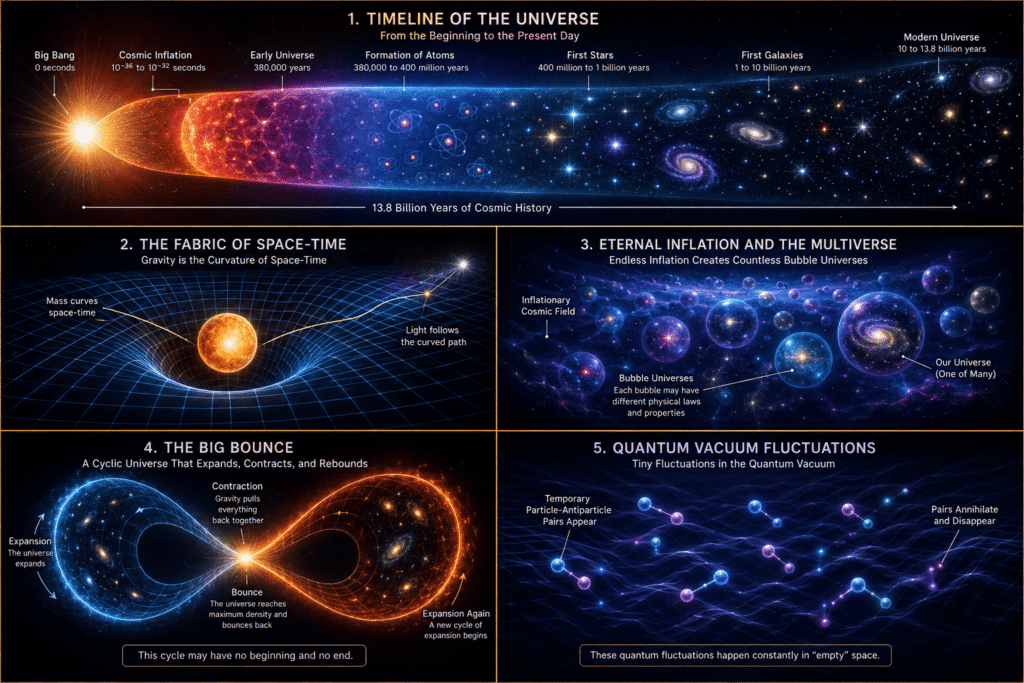
The illustration below summarizes several of the leading scientific hypotheses about what may have existed before the Big Bang. While some are actively researched and mathematically developed, none has yet been conclusively confirmed by observation.
4. Big Bounce
Figure 1. This illustration compares five leading scientific hypotheses about what may have existed before the Big Bang. These ideas are actively studied in modern cosmology but have not yet been confirmed through direct observation.