

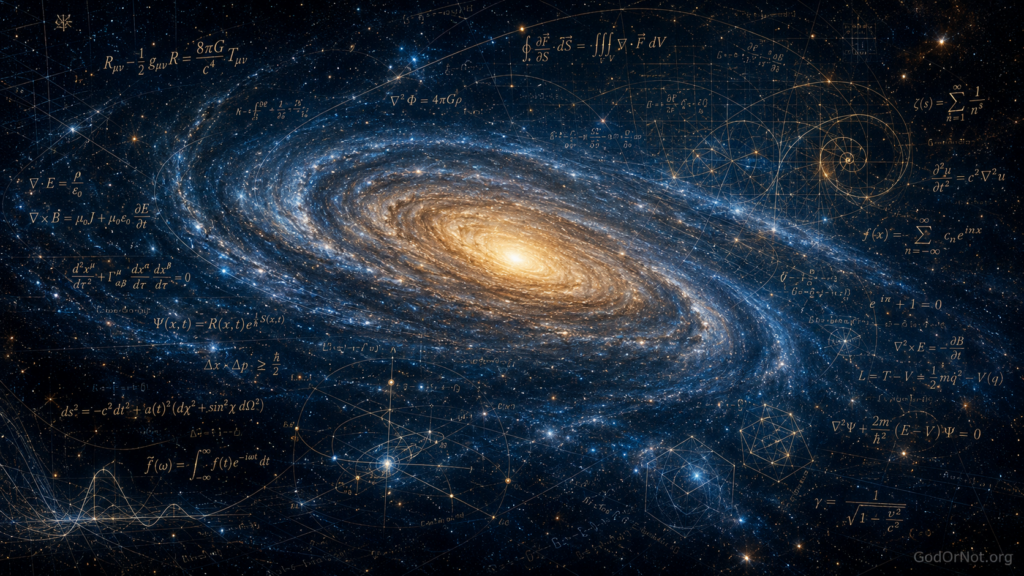
Mathematics can be understood as a universal language because it describes patterns, quantities, and relationships found throughout nature. Whether it reflects the mind of God or simply a deep feature of reality remains an open philosophical question. Is mathematics the language of God is less a settled claim than an invitation to reflect on why the universe is so mathematically ordered.
Is Mathematics the Language of God?
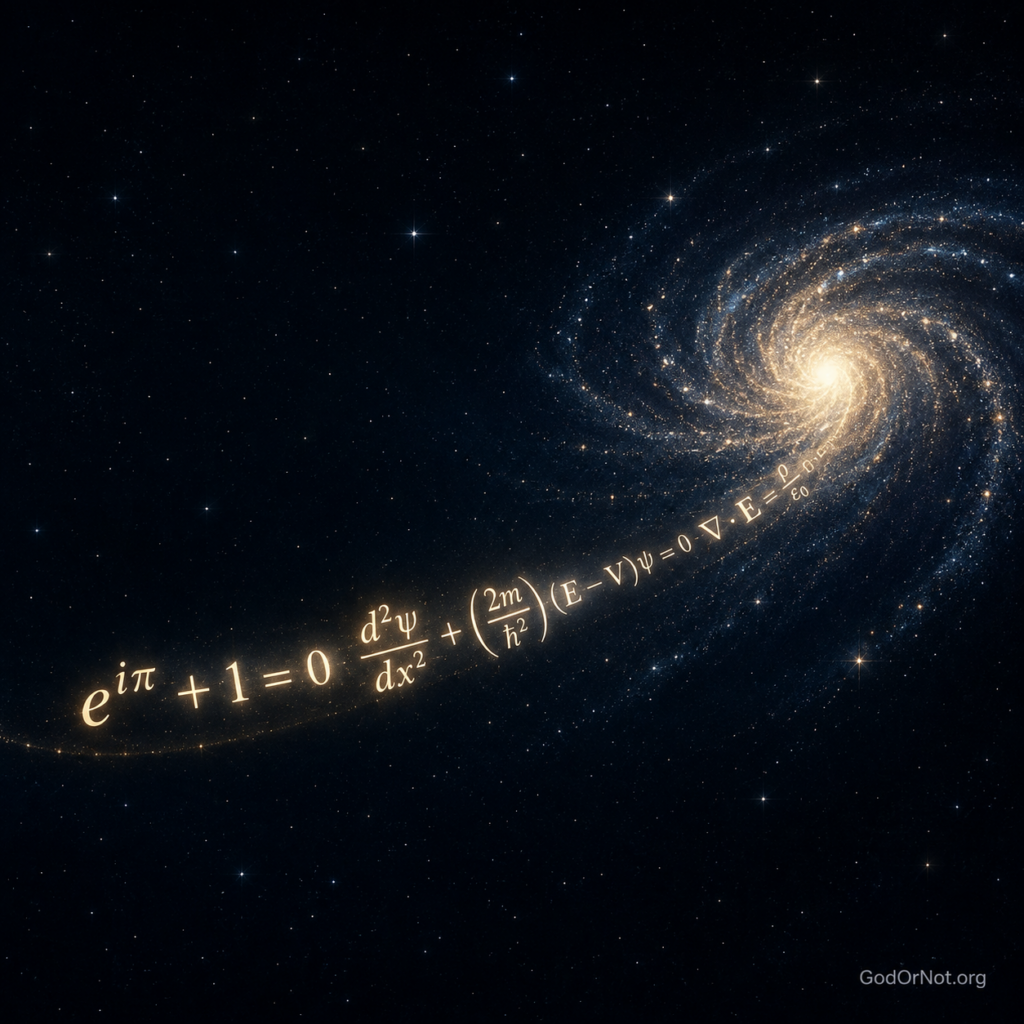
Mathematics describes reality with startling precision.
Numbers, equations, geometry, and symmetry do not just live on chalkboards. They appear in planets, atoms, galaxies, and DNA. They shape music and architecture. They sit quietly inside every law of physics.
This precision raises a deeper question. Does God speak to us through mathematics?
This article does not claim mathematics proves God. It does not claim mathematics is a spoken language from heaven. Instead, it explores whether mathematical order might point toward something deeper behind reality.
Direct Answer: Is Mathematics the Language of God?
Mathematics can be understood as a kind of universal language. It describes patterns, relationships, and structures found across nature.
For believers, this order may reflect the rationality of a Creator. For skeptics, it may reflect a powerful human tool, or a deep and unexplained feature of reality itself.
Is mathematics the language of God? No one can answer with certainty. But it remains one of the most meaningful questions where science, philosophy, and faith meet.
Why This Question Matters
Mathematics is not just useful. It is mysteriously effective.
Humans invented mathematical tools to solve practical problems. Yet many of those tools later described things no one expected.
Consider a few examples:
- Planetary motion follows precise mathematical laws.
- Gravity can be expressed in a single elegant equation.
- Electromagnetism unifies light, electricity, and magnetism through mathematics.
- Quantum mechanics predicts subatomic behavior with mathematical accuracy.
- Relativity reshaped space and time through geometry.
- Black holes were predicted mathematically before they were observed.
- The expansion of the universe was described in equations before it was confirmed.
Why should the human mind be able to understand the deep structure of the cosmos?
Is Mathematics Invented or Discovered?
This is one of the oldest debates in philosophy.
The invented view holds that humans create mathematical symbols, systems, and models. Numbers and formulas are human inventions, useful for describing the world.
The discovered view holds that mathematical truths exist independently of us. Humans do not create them. They uncover them.
Consider simple examples. Two plus two equals four, regardless of culture or language. Prime numbers follow patterns no one designed. The value of pi appears in circles across the universe, not just on Earth.
If mathematics is discovered, this may suggest reality has a deep rational structure, one that existed before any mind found it.
Is mathematics invented or discovered? The debate remains unresolved. But the answer matters for how we understand reality itself.
The Unreasonable Effectiveness of Mathematics
Physicists have long noted the unreasonable effectiveness of mathematics in describing the physical world.
Equations built through pure abstract reasoning often apply, almost perfectly, to the real universe. Mathematics has predicted unseen planets, electromagnetic waves, antimatter, and features of cosmology, all before direct observation confirmed them.
This does not prove God. But it raises a serious question. Why is reality so deeply mathematical?
[Internal link suggestion: link “the unreasonable effectiveness of mathematics” to “Why Is Mathematics So Effective at Describing Reality?”]
Mathematics in the Laws of Physics
The laws of physics are written in mathematical form.
Gravity, relativity, electromagnetism, quantum mechanics, and thermodynamics all depend on precise mathematical relationships.
This raises further questions. Why are the laws of nature stable? Why are they consistent across the universe? Why are they understandable at all? Why do equations, written by human minds, accurately describe stars, atoms, and galaxies?
[Internal link suggestion: link “the laws of nature” to “Why Do the Laws of Physics Exist?”]
Some thinkers go further and ask whether the universe itself is fundamentally mathematical in nature.
[Internal link suggestion: link “the universe itself is fundamentally mathematical” to “Is the Universe Mathematical?”]
Mathematics in Nature
Mathematical patterns appear throughout the natural world.
Spirals shape galaxies and seashells. Symmetry appears in flowers and snowflakes. Hexagons form naturally in honeycombs. Branching patterns repeat in trees, lungs, and rivers. Proportions shape music. Geometry organizes crystals. Orbital patterns govern astronomy.
These patterns are not always perfect. Nature often shows approximate, adaptive, and functional mathematical order rather than flawless precision.
Even so, the recurrence of these patterns across such different scales is striking.
Fine-Tuning and Mathematical Precision
Modern physics depends on specific constants, ratios, and quantities.
Many scientists and philosophers discuss whether the universe appears fine-tuned for life. The strength of gravity, the electromagnetic force, particle masses, and cosmic expansion are all described mathematically.
If some of these values were different, the universe might not allow stars, chemistry, planets, or life to exist.
[Internal link suggestion: link “the strength of gravity, the electromagnetic force, particle masses” to “Why Are the Constants of Nature So Precisely Balanced?”]
This remains debated. Some see evidence of design. Others point to physical necessity, chance, or multiverse theories.
[Internal link suggestion: link “some see evidence of design” to “Is the Universe Fine-Tuned for Life?”]
Does God Speak Through Mathematical Order?
Many believers see mathematical order as one way creation reflects the mind, wisdom, or rationality of God.
This does not mean God is speaking in audible words through equations. It means the structure of reality may reveal order, intelligibility, beauty, and purpose.
Does God speak to us through mathematics? For some, mathematics is not only a practical tool. It becomes a window into the deep order of creation, a language written into the fabric of the cosmos itself.
The Skeptical View
The skeptical or naturalistic view deserves equal respect.
Many people believe mathematics works because humans created it specifically to model observed patterns. Others argue that human brains evolved to detect structure, so we notice mathematical order because we are built to find it.
Still others point to a simpler explanation: if mathematics did not describe reality, life capable of asking this question would not exist.
These are serious points. But they raise their own question. Does usefulness alone fully explain why abstract mathematics maps so deeply onto the physical universe?
Evidence, Proof, and Humility
It helps to distinguish evidence from proof.
[Internal link suggestion: link “distinguish evidence from proof” to “What Is the Difference Between Evidence and Proof?”]
Mathematics may serve as evidence of rational order for some people. But it is not a laboratory proof of God’s existence.
A thoughtful person can observe the same mathematical order and interpret it differently. This does not make the question less important. It makes honest inquiry more valuable.
[Internal link suggestion: link “honest inquiry” to “Can Science Explain Everything?”]
Why Mathematics Inspires Wonder
Mathematics often feels more discovered than invented.
It connects mind and cosmos. It reveals hidden patterns behind visible reality. It allows humans to understand things far beyond ordinary experience.
A short equation can describe the motion of planets. A formula can describe the behavior of light. A mathematical model can describe the curvature of space-time. A few symbols can reveal something true about the universe itself.
Why is reality understandable at all?
Frequently Asked Questions
Is mathematics the language of God? Mathematics may not be a literal spoken language, but many see it as a reflection of deep order in the universe. Whether that order points to God remains a matter of interpretation, not proof.
Does God speak to us through mathematics? Some believers see mathematical order as one way creation reflects divine rationality and design. Others see mathematics as a natural feature of the universe, independent of any deity.
Does mathematics prove God exists? No. Mathematics does not prove God exists. It may serve as evidence of order and intelligibility, which some interpret as pointing toward design, and others do not.
Why does mathematics describe the universe so well? This remains an open question. Some point to the unreasonable effectiveness of mathematics as evidence of deep rational structure in reality. Others explain it through evolution, human invention, or the nature of observation itself.
Is mathematics invented or discovered? Philosophers disagree. The invented view holds that mathematics is a human creation. The discovered view holds that mathematical truths exist independently of human minds, waiting to be found.
A Humble Conclusion
Is mathematics the language of God?
Mathematics may not be a spoken language. But it may be one of the clearest signs that reality is ordered, intelligible, and deeply structured.
For some, this points toward God. For others, it points toward the mystery of the universe itself.
Either way, mathematics invites wonder.
If the universe can be read through mathematics, perhaps the deepest question is not only what the equations say, but why there is a readable universe at all.