
The universe began with an unimaginable explosion. Temperatures beyond comprehension. Energy beyond measure. Chaos on a cosmic scale. Yet billions of years later, one small planet sits in a quiet corner of the Milky Way — perfectly positioned for life.
How did a violent Big Bang produce something so ordered?
How did Earth end up in the Goldilocks Zone, where conditions are just right for liquid water, stable temperatures, and living organisms?
The answer spans astrophysics, planetary science, and one of humanity’s deepest questions.
What Is the Goldilocks Zone?
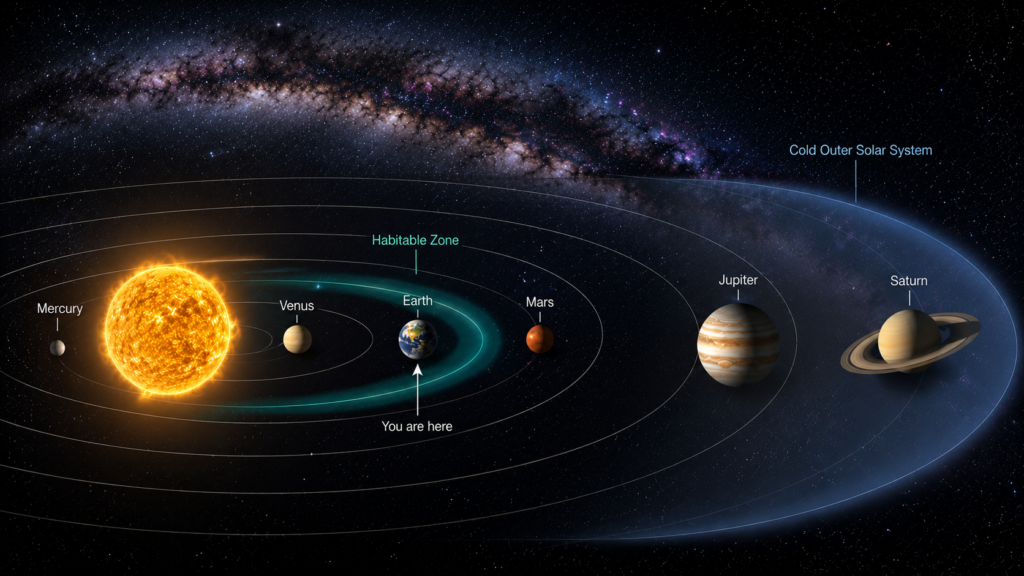
The Goldilocks Zone, also known as the Habitable Zone, is the region around a star where temperatures may allow liquid water to exist on a planet’s surface.
Earth lies within this zone around the Sun.
If our planet orbited significantly closer to the Sun, temperatures could become too hot for stable oceans. If Earth orbited much farther away, water could freeze across much of the planet.
The Goldilocks Zone is one of the most important requirements for life as we know it.
Yet it is only one piece of a much larger picture.
Layer One: A Life-Permitting Universe
Before there could be a habitable planet, there first had to be a habitable universe.
Modern physics has discovered that many of the fundamental constants of nature appear to fall within extraordinarily narrow ranges that permit life.
These include:
- The strength of gravity
- The strength of electromagnetism
- The masses of elementary particles
- The rate of cosmic expansion
If these values were significantly different, stars might never form, planets might never develop, and the chemical elements necessary for life might never exist.
Scientists continue to debate why these constants possess the values they do.
What is clear is that life depends on them.
Layer Two: A Life-Permitting Galaxy
Even within a life-permitting universe, not every location is equally suitable for life.
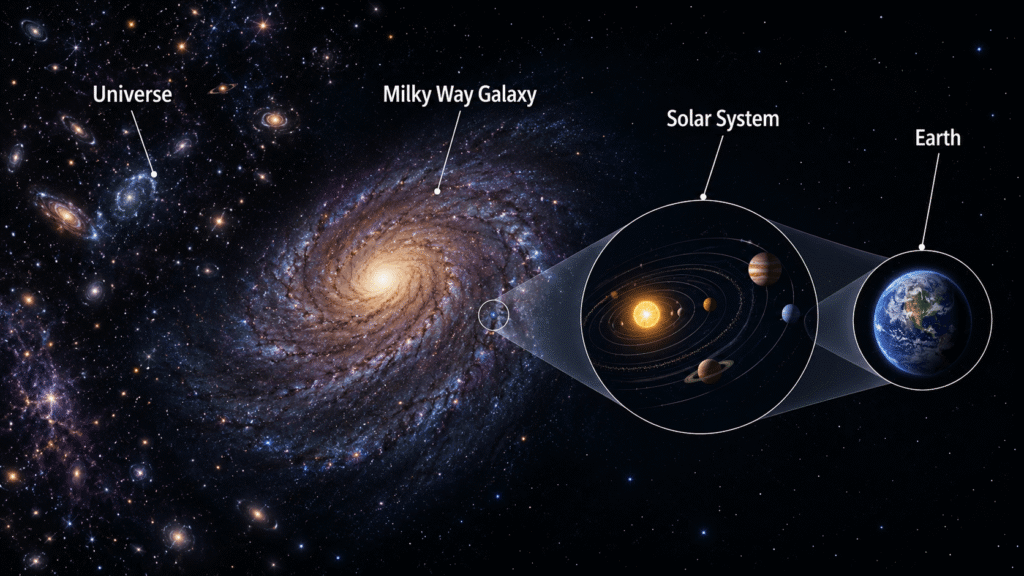
Astronomers often refer to a Galactic Habitable Zone within the Milky Way.
The central regions of the galaxy contain intense radiation, dense star populations, and increased risks from supernova explosions.
The far outer regions contain fewer of the heavier elements needed to form rocky planets.
Our solar system occupies a relatively calm region roughly halfway between the galactic center and the galaxy’s outer edge.
This location provides both the raw materials and long-term stability needed for planetary habitability.
Layer Four: A Life-Permitting Solar System
Our solar system possesses several characteristics that appear beneficial for life.
The planets follow relatively stable orbits around the Sun. Unlike some planetary systems discovered elsewhere in the galaxy, our solar system has remained remarkably stable for billions of years.
Jupiter, the largest planet in the solar system, plays an important role as well. Its immense gravity influences the paths of many comets and asteroids moving through the solar system. While Jupiter is not a perfect shield, its presence affects the overall dynamics of the planetary neighborhood.
The solar system also contains an unusual balance of rocky inner planets and giant outer planets. This architecture helps create long-term stability that allows Earth to maintain a relatively predictable orbit around the Sun.
Life requires more than the right location. It requires time.
A planet cannot support complex ecosystems if its environment is constantly disrupted by catastrophic impacts or major orbital instability.
The stability of our solar system has provided Earth with billions of years of relatively consistent conditions.
That stability appears to be another important piece of the habitability puzzle.
Layer Five: A Life-Permitting Planet
Before Earth could support life, it had to possess a remarkable combination of planetary characteristics.
Earth is large enough to retain a substantial atmosphere, yet not so massive that it becomes a gas giant.
Its atmosphere helps regulate temperature, distribute heat, and protect the surface from harmful radiation.
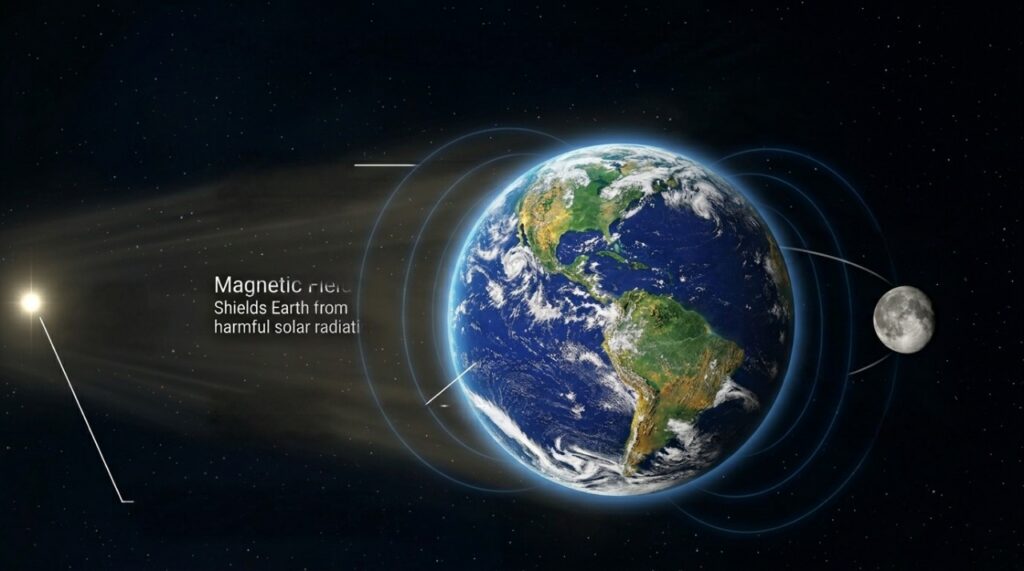
Earth also possesses a powerful magnetic field generated by its molten iron core. This magnetic shield helps protect the planet from the solar wind and other charged particles streaming through space.
Another important factor is Earth’s axial tilt. The planet is tilted approximately 23.5 degrees relative to its orbit around the Sun. This tilt produces seasons and helps distribute solar energy across the planet throughout the year.
Earth’s Moon appears to play an important role as well. The Moon helps stabilize Earth’s axial tilt, reducing extreme variations that could produce dramatic climate instability over long periods of time.
The Moon also generates tides through its gravitational influence. Scientists continue to study the role tides may have played throughout Earth’s history. Today, tides help shape coastal environments around the world.
Interestingly, the Moon is slowly moving farther away from Earth at a rate of approximately 1.5 inches (3.8 centimeters) per year. Earlier in Earth’s history, the Moon was significantly closer, producing stronger tides than those observed today.
Notice that these conditions are not alternatives. They work together. Earth’s atmosphere, magnetic field, size, composition, axial tilt, Moon, and abundant liquid water all contribute to making this planet habitable.
Taken together, they form another layer in the remarkable chain of conditions that make life on Earth possible.Earth’s Moon appears to play an important role as well. The Moon helps stabilize Earth’s axial tilt, reducing extreme variations that could produce dramatic climate instability over long periods of time.
The Moon also generates tides through its gravitational influence. Scientists continue to study the role tides may have played throughout Earth’s history. Today, tides help shape coastal environments around the world.
Interestingly, the Moon is slowly moving farther away from Earth at a rate of approximately 1.5 inches (3.8 centimeters) per year. Earlier in Earth’s history, the Moon was significantly closer, producing stronger tides than those observed today.
Notice that these conditions are not alternatives. They work together. Earth’s atmosphere, magnetic field, size, composition, axial tilt, Moon, and abundant liquid water all contribute to making this planet habitable.
Taken together, they form another layer in the remarkable chain of conditions that make life on Earth possible.Earth’s Moon appears to play an important role as well. The Moon helps stabilize Earth’s axial tilt, reducing extreme variations that could produce dramatic climate instability over long periods of time.
The Moon also generates tides through its gravitational influence. Scientists continue to study the role tides may have played throughout Earth’s history. Today, tides help shape coastal environments around the world.
Interestingly, the Moon is slowly moving farther away from Earth at a rate of approximately 1.5 inches (3.8 centimeters) per year. Earlier in Earth’s history, the Moon was significantly closer, producing stronger tides than those observed today.
Notice that these conditions are not alternatives. They work together. Earth’s atmosphere, magnetic field, size, composition, axial tilt, Moon, and abundant liquid water all contribute to making this planet habitable.
Taken together, they form another layer in the remarkable chain of conditions that make life on Earth possible.Earth’s Moon appears to play an important role as well. The Moon helps stabilize Earth’s axial tilt, reducing extreme variations that could produce dramatic climate instability over long periods of time.
The Moon also generates tides through its gravitational influence. Scientists continue to study the role tides may have played throughout Earth’s history. Today, tides help shape coastal environments around the world.
Interestingly, the Moon is slowly moving farther away from Earth at a rate of approximately 1.5 inches (3.8 centimeters) per year. Earlier in Earth’s history, the Moon was significantly closer, producing stronger tides than those observed today.
Notice that these conditions are not alternatives. They work together. Earth’s atmosphere, magnetic field, size, composition, axial tilt, Moon, and abundant liquid water all contribute to making this planet habitable.
Taken together, they form another layer in the remarkable chain of conditions that make life on Earth possible.
Earth’s Moon appears to play an important role as well. The Moon helps stabilize Earth’s axial tilt, reducing extreme variations that could produce dramatic climate instability over long periods of time.
The Moon also generates tides through its gravitational influence. Scientists continue to study the role tides may have played throughout Earth’s history. Today, tides help shape coastal environments around the world.
Interestingly, the Moon is slowly moving farther away from Earth at a rate of approximately 1.5 inches (3.8 centimeters) per year. Earlier in Earth’s history, the Moon was significantly closer, producing stronger tides than those observed today.
Notice that these conditions are not alternatives. They work together. Earth’s atmosphere, magnetic field, size, composition, axial tilt, Moon, and abundant liquid water all contribute to making this planet habitable.
Taken together, they form another layer in the remarkable chain of conditions that make life on Earth possible.
From the Big Bang to the Goldilocks Zone
When viewed individually, each of these conditions might not seem extraordinary.
- A habitable universe
- A suitable location within a galaxy
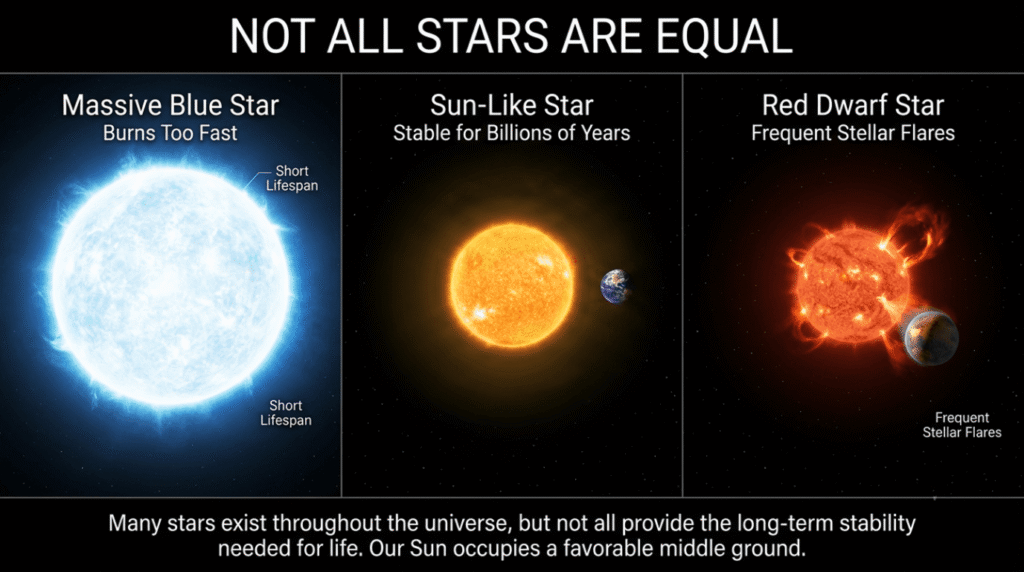
- A stable star
- A well-ordered solar system
- A planet with the right characteristics for life
Yet each layer depends on the others.
A habitable planet cannot exist without a habitable solar system.
A habitable solar system cannot exist without a suitable star.
A suitable star cannot exist without the right galactic environment.
A life-permitting galaxy cannot exist without a universe capable of producing stars, planets, chemistry, and long-term stability.
Remove any one layer and the chain breaks.
Scientists continue to study these questions, and many details remain actively debated. The purpose of this discussion is not to claim certainty about every aspect of cosmic habitability.
Astronomers continue to study galactic habitability through observations and research conducted by NASA.
Rather, it is to recognize that life depends upon a remarkable combination of conditions operating across multiple scales of reality.
From the earliest moments after the Big Bang to Earth’s position within the Sun’s habitable zone, a long sequence of interconnected factors appears necessary for life as we know it.
Whether one views these facts as the product of necessity, chance, a multiverse, design, or some combination of explanations remains a subject of ongoing discussion.
What is not debated is that life exists within an extraordinarily specific set of conditions.
And that reality continues to inspire one of humanity’s oldest questions: